

Every Voice Matters
On Creativity, Gatekeeping, and the Voices That Struggle to Become Unmuffled

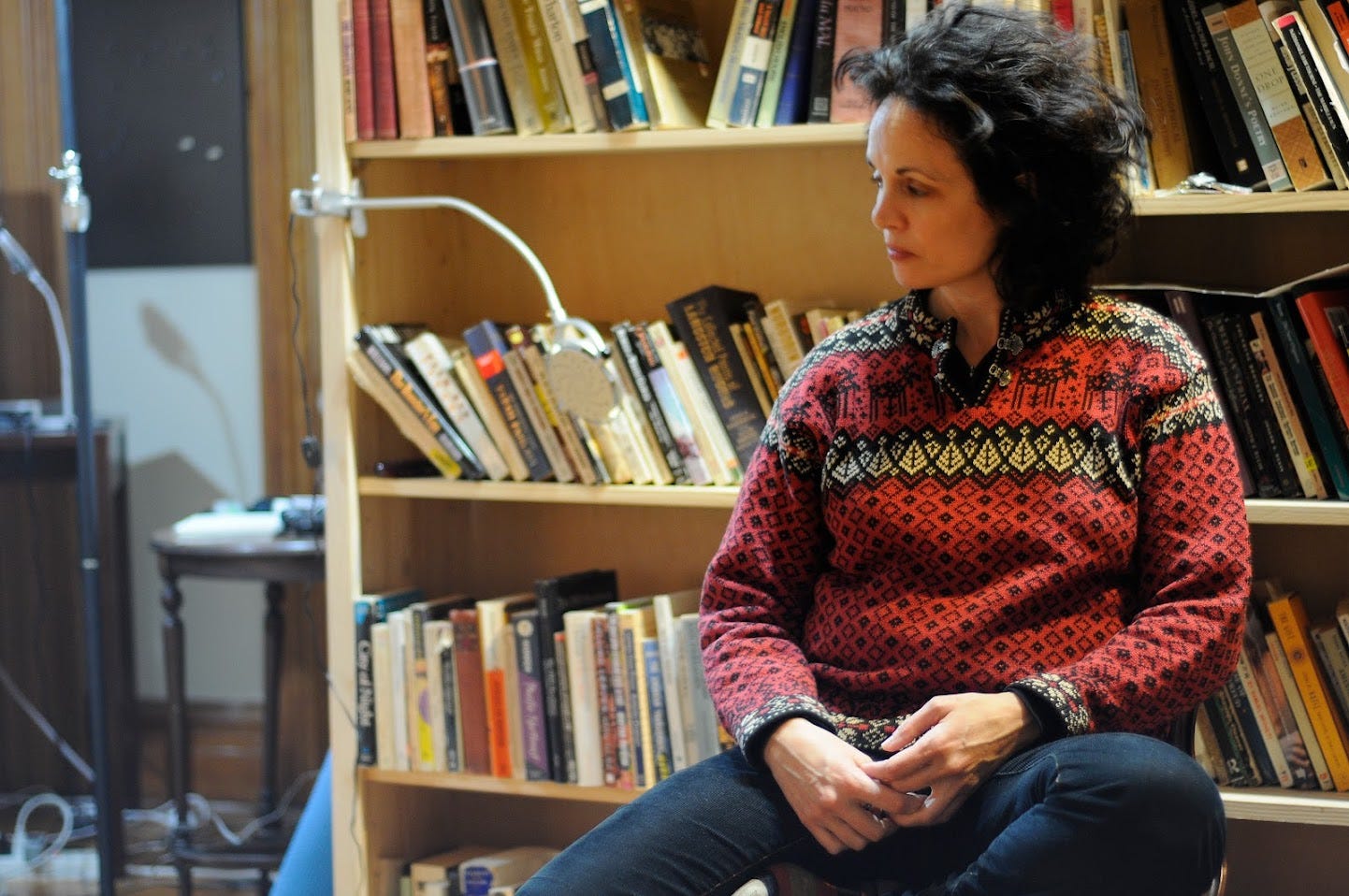
Photo of Kim Barke by Chloe Monahan, 2008
You have one life.
One angle on the world. One archive of losses nobody else inherited in exactly that arrangement. One way of hearing rain against a roof or remembering your mother’s hands as she held the iron, or walking into a room and sensing immediately that everyone else had been handed a secret manual you never received. The impulse to make something from that, a song, a poem, a painting, a theorem, a proof, is ancient. Older than the university. Older than the literary journal. Older than the person at the restaurant deciding whether your jacket looks expensive enough to permit you near the soup.
We create because silence becomes unbearable. Because something inside us keeps trying to turn loneliness into signal, grief into sound, private bewilderment into form. Because another human being, somewhere far away in geography or class or grief, may recognize the signal and answer back.
Someone does. Someone always does.
When the feeling arrives that you are not good enough, and it arrives for everyone who has ever tried to make something worthy of another human nervous system, several different voices begin speaking at once.
One says: go deeper. Listen harder. Your taste has outrun your current skill. Good. That tension is useful. The distance between what you intended and what landed is the engine of artistic growth. Every serious artist lives inside that ache for decades. Sometimes forever. Go deeper. Listen harder. Develop the skill necessary to make the thing fully alive. That voice is difficult, demanding, occasionally merciless, and essential.
The other voice is pure social poison. It whispers: who do you think you are, exactly? You think you get to be a writer? An artist? A musician? It takes every uncertainty, every awkwardness, every unfinished sentence and turns it into evidence against your right to make things at all. It makes your ambition feel embarrassing, your intensity delusional, your desire to create vaguely ridiculous.
Much of that voice is borrowed: from institutions, from workshop language, from class signals, from people who inherited confidence the way other people inherit silverware, from entire social worlds organized around the performance of effortless cultural fluency. It scans the room for tiny signs of belonging and notices the expensive ease of people who seem born knowing which books matter, which wine to order, how loudly to laugh at literary parties, how to speak in complete confidence about films they barely understood. After a while the voice settles into the nervous system and starts speaking in first person, until you can no longer tell where the original contempt ended and your own thoughts began.
Every voice matters is not a sentimental claim that every work is equally successful. Some work is shallow. Some work is derivative. Some work never risks enough to become fully alive. Standards matter. Craft matters. Discipline matters. Courage matters. Revision matters. The voice still has to sing.
But the right to create does not arise from mastery, institutional approval, or technical accomplishment. It arises from possessing a perspective that has never existed before and will never exist again. Execution develops over time. Perspective erupts from your particular nervous system and exists nowhere else on earth in exactly that configuration. There has never been another consciousness assembled from your exact sequence of griefs, class markers, humiliations, obsessions, neighborhoods, illnesses, overheard conversations, fathers drinking in silence, mothers laughing too loudly at restaurants, private shames, strange desires, old hungers, the exact texture of loneliness inside your particular life.
That perspective is unrepeatable. Culture loses entire frequencies of human experience every time a person decides their strange little inner cosmos is too embarrassing, too excessive, too unsophisticated, too improperly dressed to deserve expression in the first place. Every time someone talks themselves out of making the work at all, something specific and unrepeatable vanishes with them: a way of seeing, a way of feeling, a way of being alive on earth that no institution, algorithm, or perfectly credentialed literary darling can ever reproduce.
The deepest damage gatekeeping does has very little to do with exclusion itself. Human beings survive exclusion all the time. The deeper damage arrives when people begin amputating the strangest and most alive parts of their own perception in order to maintain proximity to power.
A voice starts hiding its strangest instincts, a sentence grows cautious, a poem learns how to behave in the good rooms. You can feel this process happening inside workshop culture in real time: the smoothing, the sanding, the removal of politics, appetite, metaphysics, vulgarity, ecstatic vision, sincerity, anything likely to make the room uncomfortable. God forbid anyone sound as though they actually mean something.
The result is competent writing with perfect bone structure and no pulse. A thousand beautifully observed kitchens. A thousand restrained divorces. A thousand emotionally literate people staring out windows while history burns three blocks away.
The tragedy is aesthetic, civic, psychological. A culture trained to distrust large feeling and collective vision eventually loses the language required to recognize what power is doing while it happens.
Long before literary culture gets hold of you, the world has already started teaching you which kinds of people are allowed to move through life with ease, and which kinds are expected to apologize for their own existence.
By high school I was already moving every day between radically different social worlds packed together inside a single school district barely an hour north of New York City. Carmel stretched across nearly eighty square miles of wealth and aspiration and working-class drift: sprawling houses out in Kent Cliffs where local television personalities and executives lived, polished developments near the high school, then places like Lake Carmel, where I grew up, smaller shabby houses crowded around the lake, people trying to hold things together without much money or ease. Academically I had been sorted into honors and Regents classes populated mostly by kids from the wealthier parts of the district, kids who seemed to move through the world without the constant self-consciousness I carried like static electricity in my skin.
Nobody announced the hierarchy outright. It lived in smaller things: the right clothes and the money to afford them, the right hairstyles, the right handwriting, the cutest boys, the effortless confidence of people who never seemed to study themselves from the outside before speaking. Between classes I stood in the smoking area with girls from my neighborhood headed toward cosmetology and food prep programs. Then I walked back into classrooms where I became painfully conscious of presentation: my Sears Roebuck clothes, my hair, my handwriting, constantly scanning myself for some uncool thing I might reveal without realizing it, something that would push me even farther into the social margins.
I started experiencing myself as a problem to solve instead of a person simply allowed to exist.
Luckily for me, all that loneliness and humiliation had somewhere to go. I wrote poetry compulsively through high school, strange little lyric eruptions full of longing, confusion, desire, class shame, and whatever parts of myself I was still trying to keep alive. Eventually I showed some of them to my English teacher, hoping perhaps for recognition, or permission, or evidence that I was not entirely ridiculous for wanting to make art in the first place. He read them carefully and placed question marks in pen beside several passages I still believe were among the strongest things I had written.
You sure you want to write about this?
I understood immediately that I had crossed some invisible line. The question marks felt less like confusion than warning, as though certain kinds of exposure required justification before they were allowed onto the page. At sixteen I could not have explained any of this intellectually. I only knew that something in those poems had made an adult suddenly cautious around me. Looking back now, I can see the gate already forming there in neat little marks of punctuation. The strangest and most alive parts of the self arrived already carrying the burden of justification.
Years later I would discover that the strange low-grade self-consciousness I carried through those classrooms had an entire sociological architecture behind it. Bourdieu spent his career mapping how taste reproduces class power. What appears natural or refined is often simply inherited familiarity wearing the costume of universality (Bourdieu, 1984). Knowing which writers to cite, which gallery to admire, which wine to order, which register to write in, these become signals of belonging long before anyone begins discussing quality.
Exposure to art really can deepen a human being. Reading widely changes what the nervous system can register. Music changes perception. Poetry changes perception. Cinema changes perception. The world becomes stranger, more textured, more emotionally legible. But “widely” cannot simply mean mastering the approved canon of upper-middle-class Western cultural fluency. It cannot mean memorizing the correct American literary references, the correct gallery language, the correct forms of ironic restraint while entire continents of human expression remain outside the gate.
A culture fed only one emotional register eventually loses its appetite for surprise. The point of cultivated perception is expansion. More feeling. More ways of being human. More ways of hearing reality itself. The problem begins when institutions mistake one narrow aesthetic dialect for universality and start confusing inherited familiarity with intrinsic authority.
Until very recently, most universities and publishing spaces spoke the language of inclusion with enormous confidence. Now many are retreating from that rhetoric the moment funding, politics, and institutional comfort begin trembling underneath them. Representation matters. Access matters. The exclusion was real. The exclusions remain real.
Still, representation and criteria operate at different levels.
You can diversify the faces inside the room while leaving the underlying emotional and aesthetic rules almost entirely intact. You can publish more writers from more backgrounds while continuing to reward the same tonal register: controlled, interior, emotionally restrained, politically cautious, suspicious of metaphysics, suspicious of excess, suspicious of ecstatic vision, suspicious of anything that arrives carrying too much actual conviction.
The table gains new seats while the menu stays the same.
The deeper question lives underneath all of it: who decided what seriousness sounds like, when, and for whose benefit? The answer, at least in modern American literary culture, turns out to involve one of the strangest aesthetic side effects of the Cold War. Picture the scene. Washington in the early 1950s. Men in suits sitting in rooms without windows discussing culture as if it were a missile system. They saw an ideological problem in Soviet art that embraced collective political vision openly. Political art organizes people. Political art creates solidarity. It reminds human beings that private suffering may have structural causes and collective solutions. For defenders of postwar American capitalism, this posed a genuine threat. Consumer culture functions most smoothly when people experience themselves primarily as isolated individuals navigating private emotional lives rather than as members of a class capable of coordinated political imagination.
So the men in those windowless rooms arrived at a subtler solution to outright censorship. Something very American in its insidiousness. Promote the opposite aesthetic. Fund the personal lyric. Elevate interiority. Reward ambiguity, restraint, fragmentation, irony. Let the small domestic image acquire the aura of sophistication while large historical vision starts feeling aesthetically embarrassing. Train writers to mistrust overt political ambition aesthetically before they ever reject it intellectually. Keep the poem in the apartment, keep the lyric in the marriage, keep history outside the room.
This is documented. Eric Bennett traces the institutional pathways clearly. Paul Engle’s Iowa Writers’ Workshop received support through organizations connected to CIA cultural operations, including the Farfield Foundation, alongside additional involvement from the State Department and the Asia Foundation (Bennett, 2014). Over time these aesthetic assumptions hardened into workshop pedagogy itself, until generations of writers inherited them simply as the natural shape of serious American literature. After a while writers begin policing those boundaries themselves.
Frank Conroy, who later directed the Iowa Writers’ Workshop for nearly two decades, described literary craft as a pyramid, syntax at the base, acceptable abstraction near the top. Work falling outside the structure failed the test automatically (Bennett, 2014). The poem locating private feeling inside political systems struggled to qualify. The novel naming historical machinery directly appeared aesthetically suspect.
Meanwhile Langston Hughes was writing about Black life in America at the exact moment Iowa’s authority consolidated. Muriel Rukeyser was writing about labor, war, technology, and power. Neruda was writing Canto General, a political epic large enough to hold a continent inside it. Adrienne Rich was moving toward a poetry that refused the separation between private life and historical structure.
By the standards of the pyramid, all of them risked sounding excessive.
What disappears when literature is trained away from historical consciousness is not merely political content. The deeper loss is perceptual. People lose the habit of connecting private suffering to larger systems. The kitchen and the policy become unrelated categories. The lyric and the empire stop touching each other.
Except they were always touching.
The kitchen is attached to the empire by plumbing.
More than fifty MFA programs emerged from Iowa graduates (Bennett, 2014). The aesthetic became institutionalized. The institution became invisible. The invisible standard began presenting itself as neutral.
A curriculum, a funding structure, an ideology wearing the clothes of craft.
Angela Davis, in Blues Legacies and Black Feminism (Davis, 1998), identifies something the architects of the pyramid never fully understood. While institutional literary culture trained itself toward restraint and depoliticized interiority, Black musicians carried enormous political, erotic, and existential force through popular form. Ma Rainey, Bessie Smith, Billie Holiday: sexuality, wandering, refusal, survival, hunger, freedom, all of it moving through three-minute songs the establishment filed under entertainment.
The deeper failure lived in perception itself. Entire institutions looked directly at radical artistic force and misrecognized it as folk culture, race music, vulgarity, excessive feeling, material insufficiently refined for the serious rooms. They lacked the framework to hear what was already happening in plain sight.
What these singers carried exceeded technical mastery. It came from history entering the body deeply enough to alter the texture of expression itself. Lorca would later circle this phenomenon in his lecture on duende (Lorca 1998), describing a force rooted in wound, mortality, earth, risk, and proximity to annihilation. The angel brings grace. The muse brings inspiration. The duende arrives hot-blooded from somewhere far less controllable.
You hear it when a flamenco singer seems to tear the notes directly out of the spine. You hear it in Billie Holiday bending time around a lyric until language itself appears exhausted by what it has been asked to carry. You hear it in certain blues recordings where the voice no longer sounds performed so much as survived.
Institutions consistently struggle with forms of art that transmit knowledge through force rather than refinement. They prefer what can be diagrammed, categorized, credentialed, explained back to itself in clean language. Duende destabilizes that process completely. It threatens hierarchy because it often arrives through people hierarchy has already dismissed.
Canonical culture repeatedly confuses polish with depth because polish photographs beautifully inside institutions. It reassures the gatekeepers that civilization remains intact. Meanwhile the dangerous work usually arrives muddy-booted, half-feral, carrying weather inside it, smelling faintly of sex, death, class conflict, religion, grief, ecstatic vision, the full electrical storm of being alive inside history.
Blues was race music before it became the foundation beneath almost all American music. Allen Ginsberg was obscene. William S. Burroughs was a junkie and a degenerate. James Baldwin was too angry, too Black, too unapologetically intelligent to fit comfortably inside the approved national myth. Jean Genet wrote from prisons and brothels. Kathy Acker was vulgar, excessive, contaminated by theory and sex and punk abrasion. The canon catches up eventually, usually decades late, after the dangerous frequencies have already altered the culture from underground.
The truly insidious part is that most of the people reproducing these aesthetics never experienced them as ideology in the first place. The Cold War architecture remained largely invisible even while it was actively shaping institutional taste. Over time the origins disappeared even further beneath the surface. What remained was simply “good writing,” “serious literature,” “sophistication,” “professionalism,” an entire emotional and aesthetic worldview quietly passing itself off as neutral reality.
Entire generations of physicians once repeated Purdue talking points about opioids with absolute confidence because the surrounding institutional atmosphere made the claims feel rational, modern, medically responsible. Culture works the same way. People inherit aesthetic assumptions so deeply they stop recognizing them as assumptions at all.
So the canon keeps arriving late to its own revelations. The same institutions that once dismissed blues, jazz, ecstatic poetry, political art, working-class voices, queer voices, immigrant voices eventually circle back decades later and congratulate themselves for discovering what had been alive the entire time. Meanwhile the old machinery keeps humming underneath everything, baking the same emotional weather over and over again for people trained to mistake familiarity for sophistication.
In every creative field, a tiny number of works become institutionally visible while millions of others remain scattered: small-circulation poems, handmade records, self-published books, songs uploaded at two in the morning from apartments with bad wiring and overdue rent. Chris Anderson eventually gave the phenomenon an economic name: the long tail, the enormous, submerged ecosystem where most human creativity actually lives while prestige culture keeps staring at the same illuminated shelf (Anderson, 2006). Most creative life happens there.
Outside the prize structure. Outside the syllabus. Outside the rooms where professional tastemakers explain the difference between seriousness and sentimentality while secretly starving to feel something real again.
The long tail is where Kathy Acker kept writing. Where blues lived before anyone decided it was foundational. Where entire immigrant literatures survived in kitchens and church basements and small presses nobody prestigious bothered to review. Where people kept making things because making them felt spiritually necessary.
Which is really the point underneath all of this.
You have one life. One perspective assembled from a set of experiences that will never occur in precisely the same way again. Your work may never become famous. It may never enter the canon. It may never receive institutional blessing from the correct cultural priests wearing expensive black clothing and discussing restraint over tiny glasses of natural wine.
None of that determines whether the work carries life.
What unlocks another human being is wildly unpredictable. A poem dismissed by a workshop may save someone twenty years later. A strange little record may become the reason another artist survives long enough to make their own work. Creativity moves laterally through culture, invisibly, crossing class and geography and time through channels institutions barely perceive.
Every culture eventually invents its own bizarre little theater of legitimacy, its own system for deciding which voices sound intelligent, sophisticated, serious, civilized, and which ones sound excessive, vulgar, naïve, dangerous, embarrassing. Meanwhile strange frequencies keep vanishing into silence because somebody learned too early what sophistication was supposed to sound like, what serious art was supposed to feel like, which parts of themselves required sanding down before entering the room.
Make the work. Make it as well as you can. Read widely. Let every tradition generous enough to offer fire alter your nervous system a little. Develop rigor. Learn structure. Learn rhythm. Learn revision. Learn enough craft that the nervous system inside the work can survive contact with another human being. Then protect the living thing inside it from the flattening machinery. Protect the part that arrived before permission.
Because culture does not stay alive through gatekeeping. Culture stays alive because somewhere a strange kid in the wrong town hears a piece of music, or reads a line of poetry, or sees a painting that feels electrically, impossibly alive, and suddenly understands that their own inner life may belong to the human conversation after all.
Leaving a comment matters more than most people realize. Essays like this are attempts at human connection across distance, class, loneliness, geography, history. When readers respond, disagree, extend an idea, share a memory, or even simply say “this reached me,” the work becomes part of a larger living conversation instead of a solitary voice drifting through the algorithmic dark. Your thoughts genuinely matter here.
References
Anderson, C. (2006). The Long Tail: Why the Future of Business Is Selling Less of More. Hyperion.
Bennett, E. (2014). How Iowa flattened literature. The Chronicle of Higher Education. https://www.chronicle.com/article/how-iowa-flattened-literature/
Bourdieu, P. (1984). Distinction: A Social Critique of the Judgement of Taste. Harvard University Press.
Davis, A. Y. (1998). Blues Legacies and Black Feminism: Gertrude “Ma” Rainey, Bessie Smith, and Billie Holiday. Pantheon Books.
García Lorca, F. (1998). Play and theory of the duende. In C. Maurer (Ed. & Trans.), In Search of Duende. New Directions. (Original lecture delivered 1933). https://www.poetryintranslation.com/PITBR/Spanish/LorcaDuende.php
WOW. Just....WOW. Here's a line that'll live with me forever: "You hear it in Billie Holiday bending time around a lyric until language itself appears exhausted by what it has been asked to carry." Perfection. Thank YOU!
Your writing is so beautiful, Kim. As a reader, I find myself repeatedly saying "yes," "yes," YES!" not only in sympathetic agreement but with joy at seeing things expressed so wholly authentically or with delighted shock that my perspective, thanks to your influence, remains malleable despite my age. 💛 - Dawn