

The Scientist and Eve:
Tarot, Consciousness, and the Cost of Knowing

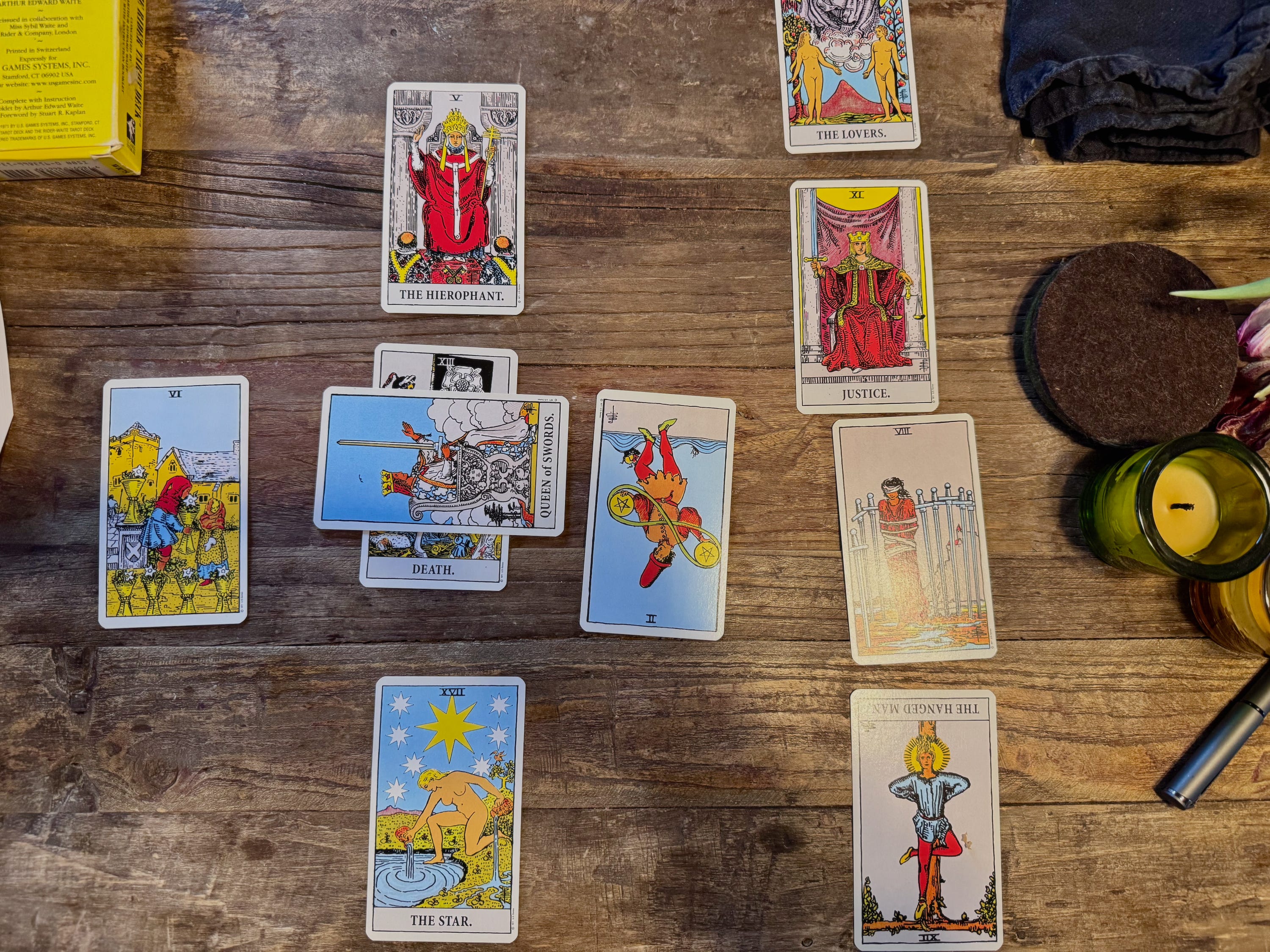
Rider-Waite Tarot Deck® © 1971 U.S. Games Systems, Inc. Photograph by Kim Barke 2026
I hadn’t done a Celtic Cross reading for myself in decades. Lately I’d fallen into the habit of pulling one or two cards the way people check the weather. A flicker of intuition. A private voltage. This time I wanted the whole ceremony. I spread all ten cards across my kitchen table with the gravity of someone laying out surgical instruments, Jodorowsky’s The Way of Tarot open beside me.
The first card I turn is Death.
Of course it is.
Not metaphorical death. Not “transformation” in the soft Instagram sense where a woman in linen learns boundaries and buys crystals the color of sea glass. I mean the actual card: the skeleton king on the white horse, the bodies under hoof, the strange calm on the horizon where the sun might be rising or setting. Tarot never fully clarifies whether you are approaching revelation or ruin. That ambiguity is part of the machinery.
I sit there staring at it while the refrigerator hums behind me and the late afternoon yellows the kitchen the color of old nicotine. I am sixty-one years old and suddenly fourteen again. Different house. Different surface. Different deck. Same card arriving with the unnerving confidence of something that already knows your address.
I have tried to tell this story before and failed every time.
Part of the problem is that the story requires a certain kind of listener. Someone willing to sit inside uncertainty long enough for it to breathe. Someone who understands that symbols can alter a life. I recently took a class with Phil Ford called A Musical Tarot, and it gathered exactly those kinds of people: intellectuals, philosophers, artists, composers, beautiful fringe-dwellers with one foot in scholarship and the other in the strange. Even there, I nearly told it and then retreated.
My first deck came from Books and Records in Carmel, New York, the town where I grew up. I’d found a reference to Tarot in The Great Escape, one of those sprawling countercultural catalogs packed with communes, occultism, Eastern philosophy, astrology, underground art, survivalism, altered consciousness, all the glittering contraband of the 1970s mind. I bought the book at Ames Department Store beside fluorescent racks of tube socks and discount Tupperware, which feels exactly right in retrospect. The weird always enters through ordinary doors.
Books and Records was heaven to me then. Books. Vinyl. Posters. Smurf figurines. Incense. The low electrical thrill of becoming someone. It was also, though I didn’t know it yet, the place where I bought the object that would split my life into before and after.
Being into Tarot in the late 1970s carried a very different charge than it does now. Tarot had not yet become aestheticized into moonlit branding for wellness influencers with affiliate links and impeccable eyeliner. It still frightened people. The Moral Majority was rising. Satanic Panic was beginning to pulse through the culture like an infection moving under the skin. The country had become obsessed with the possibility that evil could enter through curiosity itself.
The Exorcist. Rosemary’s Baby. Carrie. The Omen.
Again, and again the same warning: an innocent opens the wrong door, and something enters.
I was fourteen years old walking directly toward the door with cash in my pocket.
Fearless is one word for that. Reckless is another. Mostly, though, I believed. Entirely. Not in the shallow performative sense people use now when they say they “love Tarot,” as though they are discussing candle scents. I believed the cards possessed force. Teeth. Consequence. I believed symbols could look back at you.
I wrapped the Rider-Waite deck in a silk scarf my mother had given me and kept it under my pillow like a forbidden animal breathing quietly in the dark.
Present — Death (XIII)
Every Tarot reader does it. I’ve done it myself. The moment the Death card appears, we rush to reassure.
“Don’t worry. It doesn’t mean actual death.”
The sentence arrives almost automatically, like a reflexive little priestly gesture meant to calm the congregation before anyone starts screaming in the cathedral. Somewhere along the way we declawed the card. We house-trained it. We turned Death into “transition,” “rebirth,” “a new chapter,” as though the skeletal rider were simply announcing a tasteful kitchen renovation and an exciting opportunity for personal growth.
But death does mean death.
Not always. Not predictively. Tarot is symbolic language, not a subpoena from the universe.
Still, the frantic insistence that Death cannot possibly refer to actual mortality feels psychologically revealing. We permit the card to signify ego death, career shifts, divorce, spiritual awakening, shedding old patterns, almost anything except the one thing the word itself unmistakably names.
Meanwhile every living thing on earth is moving steadily toward extinction with astonishing consistency.
Jodorowsky dismisses literal death as simplistic. Most Tarot writers and readers interpret the card as transformation, and certainly transformation lives there too. Death rearranges the architecture of a life. It severs timelines. It changes the weather inside the body. Yet Tarot already contains numerous cards capable of carrying transformation without requiring this extraordinary amount of interpretive gymnastics. The Tower detonates reality. Judgement resurrects it. The Wheel of Fortune alters fate. The World completes a cycle. The Star restores hope after devastation. Even the Aces crack open new beginnings like seeds splitting underground after rain.
But only one card is Death.
Only one rides forward carrying the oldest fact of biological existence in its bare white hands.
So, what exactly are we protecting ourselves from when we soften it?
Ernest Becker argued that much of culture functions as a defense against mortality. We build religions, ambitions, bloodlines, wellness rituals, monuments, entire civilizations trembling around the same impossible knowledge: the body ends.
Or perhaps Tarot readers fear something stranger.
Not being wrong.
Being right.
Because predicting death, even symbolically, places both reader and querent for one unbearable second inside the unsoftened truth. The room changes temperature. Language loses some of its decorative function. Everyone remembers the contract they signed simply by being born.
And so, we rush in with euphemism. Transformation. Transition. New beginnings.
Anything to pull the black horse gently back into the stable before it reaches the center of the room.
Crossing — Queen of Swords
Crossing the Death card in this reading is the Queen of Swords, one of the great unsentimental minds of the Tarot. She is intellect after devastation. Clarity sharpened on grief. The woman who has suffered enough to stop decorating reality. No euphemism. No incense cloud. No spiritual baby talk. Just the blade.
I laughed when I turned her over because the card could not be more painfully on the nose.
This is the exact tension running through the center of my life and through the center of this story.
I was trained as a scientist. I spent years inside laboratories, statistical reasoning, neurochemistry, biological mechanisms, the disciplined architecture of evidence. I prefer rational explanations. I distrust magical thinking. I understand how easily human beings impose narrative on randomness, agency on coincidence, intention onto the indifferent static of the universe. The brain is a pattern-detecting engine so hungry for meaning it will manufacture constellations out of noise.
And yet the story I am about to tell you is not rational.
Crown — Six of Cups
The afternoon before the slumber party was the last afternoon before knowledge arrived.
Dawn’s bedroom was dark against the July heat outside, the shades pulled down, the air conditioner rattling softly in the window. We lay on the carpet with our elbows pressed into the floor while Jill’s favorite album, Dark Side of the Moon, spun beside us. The heartbeat at the beginning, and the bassline from “Money” moving through the carpet. Cash registers crashing open and shut in the dark.
Dawn was turning fourteen. I had turned fourteen in April. Jill Garrett, Dawn’s neighbor, was fifteen and impossibly sophisticated to us. Feathered blonde shag, heavy eyeliner, a way of leaning against the wall like everything bored her slightly. You wanted her approval immediately and understood you probably wouldn’t get it.
The record hissed between tracks. Somebody opened a can of Coke. Outside, the Hudson Valley summer pressed against the windows while inside the room felt sealed off from ordinary life, cool and dim and suspended.
It was Jill’s turn for a reading.
I had been practicing constantly by then, carrying the deck everywhere, sleeping with it under my pillow, trying to memorize the Celtic Cross spread from books where every symbol seemed connected to hidden forces waiting just beneath the visible world.
I laid the cards down one by one across the carpet between us. Jill was staring straight at me. Her dark blue eyes sliced into mine.
Past. Present. Crossing. Foundation.
Nobody spoke while I turned them over. Dah, dah, dah, dah, bum, bum bum…Even at fourteen you could feel when a room changed.
Then I reached the final card, the one at the end of the straight line. Outcome.
Death.
All this time I was avoiding her eyes, and now a self-conscious feeling consumed me. I made excuses and moved immediately to soften it, saying how none of this really means anything anyway and that the Death card can be a great change or disruption. Jill wasn’t one for subtleties, she decided instead to make light of it. Her eyes lit up, and she joked that maybe a car would hit her tomorrow, and with that dismissed the whole thing. I put my cards away, even though some of my other friends still wanted me to read their fortunes.
I retreat.
Foundation — Two of Pentacles
I knew, and knowing is impossible.
I could not tell people who read Tarot because the knowledge involved a murder, and they had already domesticated the Death card into metaphor, transition, transformation, anything except death itself.
I could not tell fellow scientists because the channel was Tarot.
Two realities in the air for forty-seven years. No one watching. No one to hand them to.
Recent past — The Star (XVII)
It’s here with the Star card that the juggling finally comes to rest.
According to Jodorowsky, “the Star card sometimes prompts us not to decide upon two irreconcilable options… but instead to conciliate the two.”
That line stopped me when I read it because I had spent forty-seven years believing I had to choose: dismiss what happened as impossible or surrender entirely to belief in the supernatural.
The Star suggested something stranger.
The poem arrives. The melody arrives. The cards arrive. Human beings have always stood at the edge of knowing, receiving things before understanding how they arrived.
It’s inevitable when thinking about knowledge to arrive at the Garden of Eden. Adam and Eve eat the fruit and awareness floods in all at once, hot and irreversible. Suddenly they see. Skin. Shame. Mortality. Distance. The entire terrible glittering catastrophe of consciousness.
The serpent’s promise was accurate: they would know.
And once knowledge enters the body, paradise is over.
Near future — The Hierophant (V)
Science is esoteric.
Self — The Hanged Man (XII)
I was not being punished. I chose this.
I chose knowledge over the comfort of not knowing. I have been hanging between knowing and telling for most of my life.
I looked, I saw, the knowledge was accurate, and I was expelled from ordinary teenage life, from the comfort of not-knowing, from the ability to simply remain inside experience without this thing permanently inside me.
The knowledge lodged in me the way a possession lodges. I could not put it down. I could not tell anyone. It lived in me for forty-seven years.
Like the child in The Exorcist, something entered through an innocent act of curiosity. But it was not a malevolent force, it was simply true.
The entire project of science is eating from the Tree of Knowledge, deliberately and systematically: more knowledge, always more, regardless of the sacrifice. I built my professional life on that premise. And then the one piece of knowledge that changed my life arrived through a channel science could not account for, knowledge that came through Tarot cards and my fourteen-year-old hands in a darkened bedroom, with no legitimate framework to hold it.
There’s no exorcism for accurate knowledge.
Environment — Eight of Swords
The Eight of Swords is the card of entrapment, though the trap is strangely porous. A woman stands blindfolded among upright swords, bound loosely enough that she could free herself if she understood what held her there. The prison is partly perceptual. Fear closes the circle before reality does.
In this reading, the card belongs to Jill.
I was lying on my bed late that afternoon, leaning back against my pillow and staring at the postcards taped to the wall, letting my eyes drift in and out of focus. Then I heard my mother’s footsteps in the hallway, the hard clip of her slingback shoes against the linoleum floor.
When she opened the door, she stayed in the doorway instead of coming in. She was wearing a navy pantsuit with a striped knit sweater underneath. Her face carried the same sharp elegance as the outfit itself: bright eyes, cool smile, cigarette between her fingers. She paused to take a drag and her mouth tightened slightly before she spoke.
They found a girl named Jill Garrett dead by the creek near the farm where your friend Jody lives.
Then, after a pause:
Did you know her?
There was no preparation in her voice, no awareness that the room had just split in half.
I told her yes and started trembling almost immediately. I looked down at my T-shirt because I could no longer look directly at her face. It felt as though the space beneath my ribs had opened into something hollow and airless. I kept trying to breathe normally and couldn’t. Still, I did not cry. I wanted whatever this was to happen privately inside me.
She tilted her head slightly to the right.
She was a good friend of Dawn’s, I said. I met her at Dawn’s sleepover.
My mother nodded, said she was sorry, then turned and closed the door behind her.
I reached beneath my pillow for the cards.
I sat cross-legged on the bed and untied the silk scarf my mother had given me. My breathing had steadied by then, but my heartbeat felt enormous inside my chest. I opened the box and let the deck slide into my hands. The cards spread loose across the white bedspread.
Then I gathered them back together, carried them across the room to the garbage pail, and tore them in half in terror.
Everything flooded in at once: occult danger, demonic entry points, doors that should never be opened. The Exorcist. The Omen. Church sermons. Television specials. Adults speaking in lowered voices about evil.
And now a girl whose cards I had read was dead.
Card after card splitting under my hands. I wanted the knowledge gone.
A few weeks later at school, I remember walking toward Dawn’s older sister in the smoking area behind the building. Yes, we had smoking areas in high school in 1979. As I walked toward her, she looked directly into my eyes, and I felt certain she knew.
About what I had known before anyone else did.
And suddenly the knowledge changed into guilt.
I lived with the feeling that somehow, I was responsible for Jill’s death. That by touching whatever moved through those cards I had participated in something terrible.
Hopes and fears — Justice (XI)
April 1980, in New City, 40 miles away from Carmel, a 31-year-old man named Franklin Morrison was convicted of raping and murdering 15-year-old Jill Garrett. The trial had been moved out of Putnam County because the murder had so inflamed the town that an impartial jury was considered impossible. He was given the maximum sentence 12 ½ to 25 years for rape and 25 years to life for murder. The judge decried the viciousness and brutality of the killing.
I learned that Jill had been at a party with her boyfriend and when they had gotten into a fight, she decided to hitchhike home.
Justice arrived afterward in a courtroom forty miles away.
It just didn’t arrive for Jill.
Outcome — The Lovers (VI)
This is the essay that wasn’t supposed to exist, written by someone who wasn’t supposed to write it, about knowledge that wasn’t supposed to be real.
Which may be why, when I turned over the final card in this reading, I couldn’t understand it at first.
Every other card in this Celtic Cross felt uncannily precise. But this last card, appearing in the same position where I had once read Jill’s death, made no sense to me at all.
The Lovers is the card of union, of separated things finding each other again. Two figures beneath an angel, standing inside a force larger than either one alone.
For most of my life I kept these parts of myself partitioned into rooms inside the same house. The scientist in one room. The fourteen-year-old girl in another. Laboratory light on one side. Candlelight and cards on the other. One life built from evidence and peer review. Another built around a piece of knowledge that arrived like a punch in the gut and never left.
The arrangement preserved order.
It also preserved silence.
I never doubted the reality of what happened in Dawn’s bedroom, while The Dark Side of the Moon played on the stereo. I felt it so strongly in my body, immediate and undeniable. It never loosened its grip on me, no matter how rigorously I later learned to question everything.
Forty-seven years is a long time to carry a secret that rearranges reality from underneath.
Long enough for the fourteen-year-old girl and the scientist to finally become the same person again.
The poem arrives. The melody arrives. The cards arrive.
An amazing piece.
Kim, this is an extraordinary piece of writing and a courageous act of bearing witness. Found my way here from Weirdosphere where you recommended a film. I’ve not written my Tarot story yet, not sure how and not ready, but reading this makes me think that a chat with you might be helpful. Message me anytime if interested.